Satisfying Interdisciplinary Instincts with Economics, Sociology, and Statistics
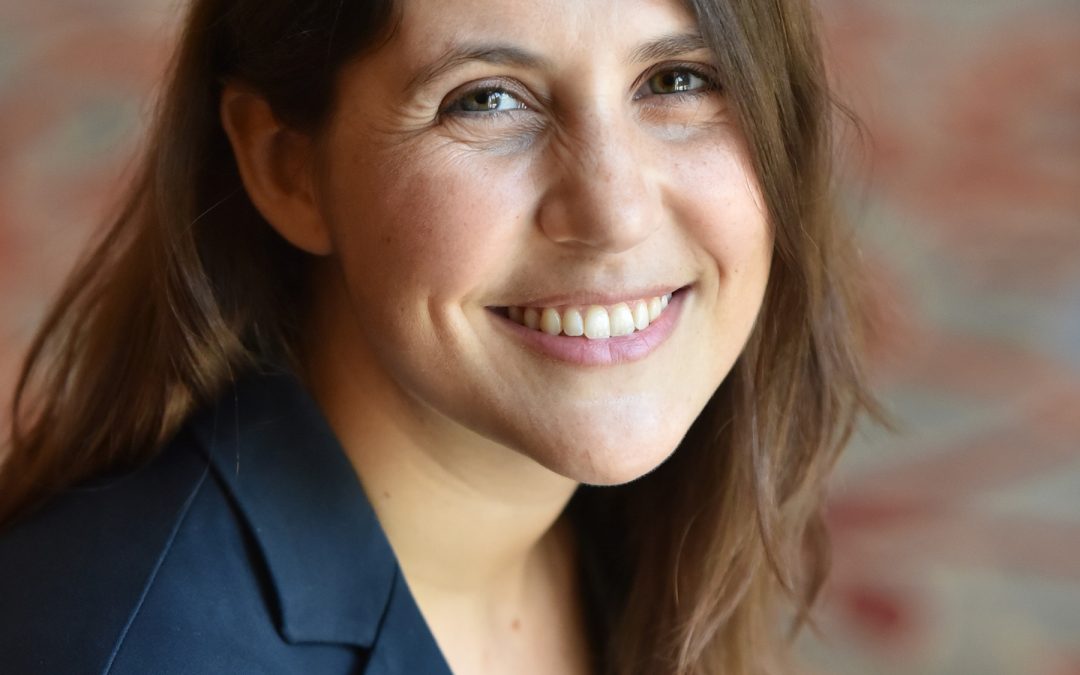
Today, Dr. Noura Insolera is the Assistant Director of the Panel Study of Income Dynamics (PSID), and an Assistant Research Scientist at the Institute for Social Research (ISR) at the University of Michigan, but she didn’t plan to be a social scientist.
Noura knows that ISR, where she has spent her career studying social inequality, is a place “unlike any other.” When she speaks about numbers, the data isn’t dry and boring; it’s deeply personal and profoundly social.
Growing up in Michigan, she thrived in math and science. “As an undergrad, I entered the University of Michigan in the Women in Science and Engineering program,” she said. “But I dropped the first biology course I enrolled in. I realized if I wasn’t interested in this class, I wasn’t going to like what followed,” she explained.
Noura decided to change her major to Economics. “I thought economics would be marketable and show people that I could think logically and do math,” she said. Yet, it wasn’t until an Economics course with Frank Stafford, then director of PSID, that shifted her trajectory. That course opened her eyes to the world of survey research, where “you could look at the answers of actual people and glimpse how they really live—and those answers weren’t always rational, which is what econ assumed.”
That class was Noura’s first experience in looking beyond numbers and models to uncover the lives and people behind the figures and charts.
Bridging Disciplines, Broadening Impact
That same curiosity led Noura to a diversity internship at ISR in the Survey Research Center as an undergraduate—her “mini PhD,” as she called it. “I wrote to Frank and said, ‘Can I work with you this summer? You don’t have to pay me.’” The internship program was 10 weeks long, but set the path to where she is today. She worked with a cohort of interns, all stationed in different departments, building toward an end of summer symposium where they showcased their work to the whole of ISR.
Afterward, she stayed on as a temporary employee, sharing an office with our own Stone Center Director Sasha Killewald, then a graduate student at Michigan. The internship allowed her to see “how the world of research really worked.”
It was mentors like Sasha, Frank, Bob Schoeni, and Kate McGonagle who nudged Noura to pursue graduate work, which led her to Columbia University for a master’s in quantitative methods—a blend of economics, sociology, and statistics that Noura said fit her interdisciplinary instincts. Eventually, even as she completed her doctoral work in Sociology and Demography (and started a family) at the City University of New York’s Graduate Center, her “real committee” remained the team back in Michigan.
Getting to know the PSID
Noura’s research explores how income inequality affects health and educational outcomes over a lifetime and across generations. She uses the PSID—the legendary longitudinal study following U.S. families for more than 50 years—as both microscope and telescope: peering into granular details of life while charting broad, generational arcs.
Her interest in obesity among children began with her own observations in children in public and private school. Noura began her education in public school but after middle school, she was awarded a scholarship to Cranbrook Kingswood, a prestigious private school. She transferred there in 9th grade. “I noticed at my public school there were a lot of obese kids, but at private school, there were very few. I knew it was about more than just resources—it made me wonder why,” she recalled.
For Noura, the “work is constantly evolving.” Recent projects explore how government programs (like SNAP, WIC, or Medicaid) support families—and how gaps in program design and coordination can undermine these efforts. “It was initially so surprising to me, but government programs often don’t fit together as you’d expect. You might think eligibility for Medicaid means you’d automatically get food stamps,” she explained. “But that’s not the case. The systems don’t always align, the applications are confusing, and access is difficult—especially for those who most need help.”
From childhood obesity, Noura’s research expanded into economic factors, nutrition, extracurricular activities, and the differing weight of opportunity. “PSID’s Child Development Supplement had all this information—on nutrition, activities, income, and more. It really made clear how inequality shapes life from the start.”
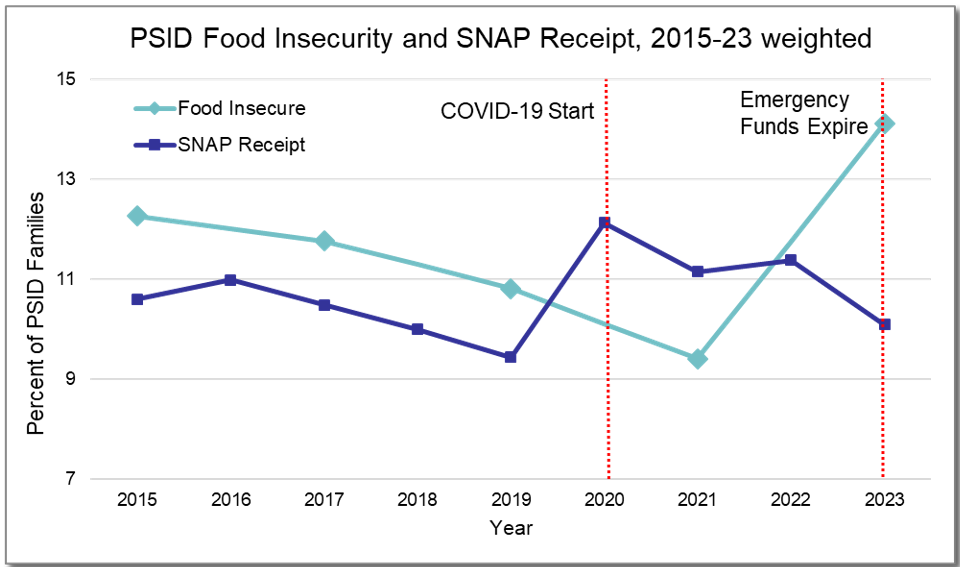
Then, the COVID-19 pandemic provided a unique test of the systems. “Amazingly, U.S. policy expansions during the pandemic actually helped. Food insecurity didn’t rise as everyone feared. But the 2023 data shows what happens when those enhanced benefits are cut: it’s not good.”
For Noura, what happened is a cautionary tale and a call to action. “If we could do it once, we could do it again.” In her research, she continues to study the effects of expiration or reduction of these benefits, emphasizing the importance of data in evaluating both positive outcomes and ongoing needs.
Her hope, Noura said, comes from a focus on incremental progress: “Not everyone will end up perfectly happy or healthy, but I can see through the longevity of the PSID data how families improve— it demonstrates that even small changes matter.”
Collaborating Across Disciplines
Noura’s own journey reflects the PSID’s journey from an economic study at its founding to a truly interdisciplinary study. “We constantly ask which journals our [PSID] data are being used in—demography, sociology, economics—and make sure our surveys include questions that other disciplines need. It’s a delicate balance, but it’s what makes PSID invaluable.”
Noura decided to join the Stone Center for Inequality Dynamics (CID) in Summer 2024. It has already broadened her horizons, she said. “Walking into CID was nerve-wracking at first—so many brilliant, different people. But it’s so energizing: everyone’s focused on the same big questions, even if our skills and fears are different.” Collaborative projects—like a new effort to measure housing insecurity more effectively in the PSID—emerge organically from these cross-pollinations. One of Noura’s newer projects focuses on how PSID’s housing questions compare to other national surveys and explores ways to enhance data collection through new linkages and revised survey instruments.
From her first internship as an undergraduate in 2007 to her first full-time position as a research assistant with the PSID in 2009 that took her through her graduate work, Noura’s career at ISR has spanned significant change and growth. What’s kept her here? “Staying curious and staying involved is key.” Besides technical changes—improving housing questions, re-linking to national data—her hope is that PSID and ISR remain places where all types of voices contribute.
“ISR supports interdisciplinarity, not by talking about it, but by doing it,” she said. “I feel at home here. We’re shaping something fundamental for science and society.”
Above all, Noura said she is motivated by the conviction that showing improvement—even in small, difficult places—can shape policy and change lives. “It should be obvious that feeding people is good. But sometimes it takes data to make others believe it. I’m here to help tell those stories, one dataset at a time.”