by Jared Wadley, Michigan News
Local governments are responsible for many services people rely on daily, like schools, parks and public safety. But the money available to pay for these services depends heavily on how much taxable property wealth sits inside each city or town’s borders. And those borders can make a huge difference.
A new University of Michigan study shows how the patchwork of city boundaries and economic segregation combine to create a “tax base fragmentation.” In simple terms, this means that property wealth is unevenly spread out across the many small cities, towns and villages inside a metro area. Some places end up with tons of taxable wealth, while others—sometimes right next door—have very little. And that affects how well each local government can fund basic public services.
Researchers analyzed 138 million property tax records across the country to map out where property wealth is concentrated. In many large cities, the gaps are extreme—and are shaped not only by income inequality, but also by the way state laws allow regions to be carved into many tiny local governments.
The team created two new metrics:
-
How fragmented the tax base is in each metro area—basically, how unevenly property wealth is split up across local jurisdictions.
-
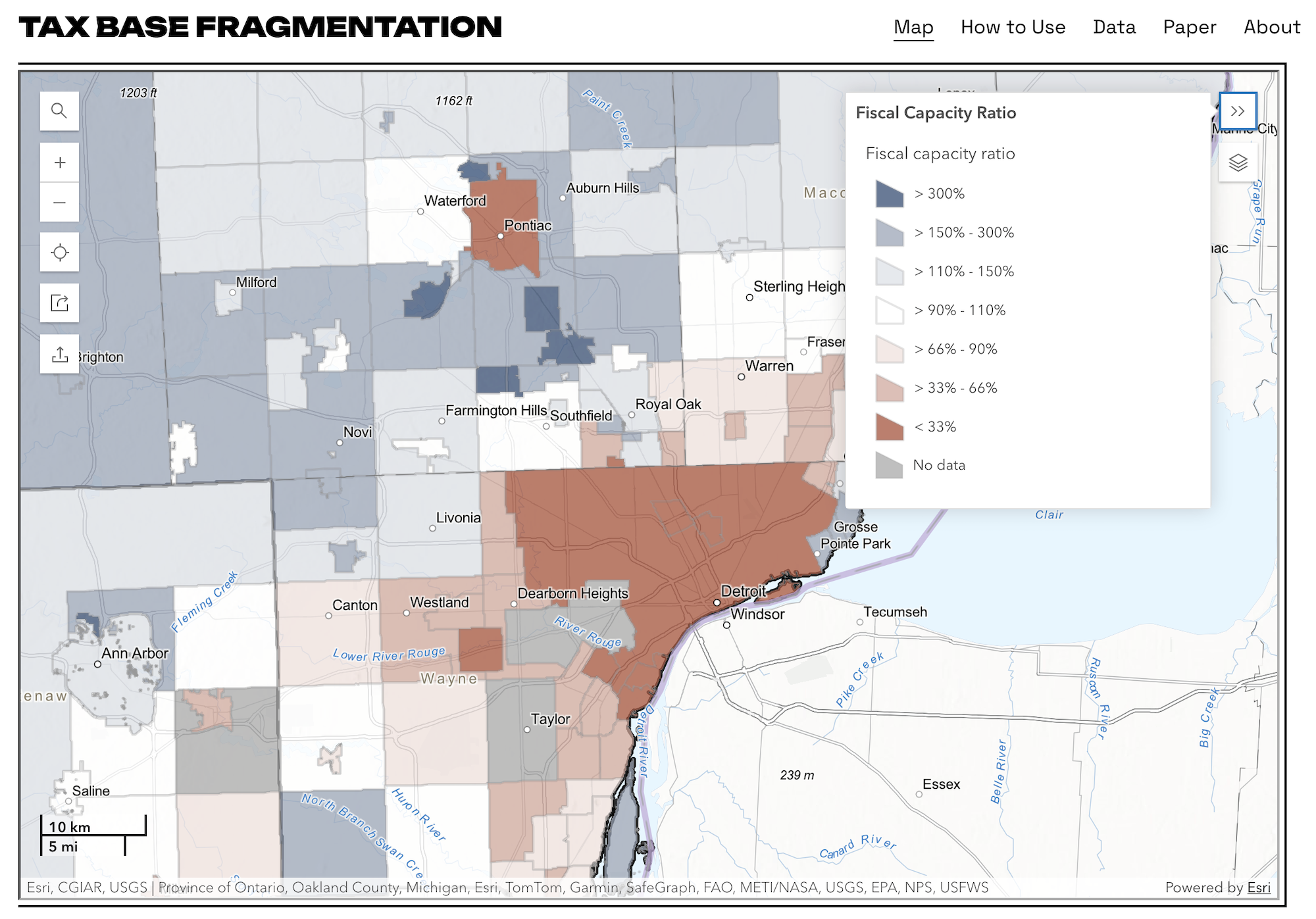
The fiscal capacity of every jurisdiction—or how much property wealth per person each city has, compared to its own metro area.

Robert Manduca, assistant professor of sociology, faculty affiliate of the Stone Center, and the study’s first author, notes that the findings show major inequality across hundreds of U.S. metros. In some states, laws allow wealthier areas to form separate municipalities, keeping their property wealth inside small borders rather than sharing it with surrounding communities. This creates big winners and big losers—even in metros that look wealthy overall, he said.
The study also identified places researchers call “municipal tax havens” and “fiscally impoverished jurisdictions.”
-
Municipal tax havens are ultra-wealthy cities with far more property wealth per person than the rest of their metro area. This includes places like Malibu and Miami Beach, but also Lake Angelus and Bloomfield Hills outside of Detroit, and many smaller towns people probably have never heard of.
-
Fiscally impoverished jurisdictions are on the opposite end: struggling municipalities with tiny tax bases that make it hard to fund even basic services. In Michigan, these include Detroit, Inkster, Flint and Saginaw, among others.
Overall, the study shows that tax base fragmentation is a major—and often overlooked—driver of inequality between communities in the same metro area. It highlights how local boundaries can protect wealth in some places while deepening financial stress in others.
The study appears in Socio-Economic Review. Co-authors with Manduca are Brian Highsmith (UCLA) and Jacob Waggoner (Harvard). To accompany the study, the researchers created an interactive web visualization mapping the fiscal capacity of every municipality nationwide, which allows users to examine tax base fragmentation in their own metropolitan areas.