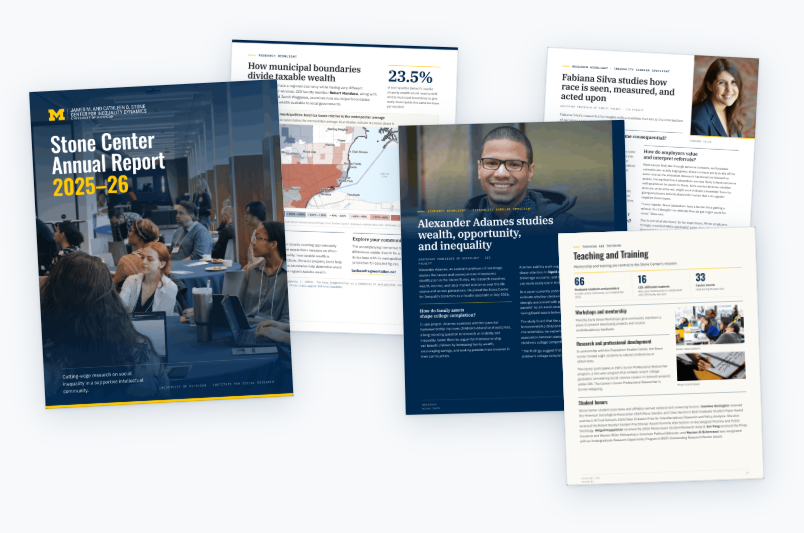
Four scholars receive 2027–29 faculty grants to study education, property taxes, the geographic distribution of wealth, and its transmission from parents to children.
Has the wealth gap between college graduates and nongraduates grown across birth cohorts? Can differences in local property taxes widen household wealth gaps? And how is wealth distributed across states, counties, and congressional districts? Three projects supported by the Stone Center for Inequality Dynamics will investigate these questions and develop data resources for studying inequality in the United States.
The Center’s 2027–29 faculty grants will support four scholars working on three projects: Alexander Adames, Robert Manduca, and Pablo Mitnik and Joe LaBriola, whose separate awards support their work on the Wealth and Mobility Study.
Education and the wealth gap
Alexander Adames
College graduates tend to earn more than people with less education, but how does that advantage translate into accumulated wealth? Adames will investigate whether the wealth gap between college graduates and nongraduates has increased across birth cohorts—groups of people born in different periods—and whether it differs depending on parents’ education.
His project, “Education and the Intergenerational Transmission of Wealth Inequality Across Cohorts,” will also examine how the educational wealth gap varies across types of assets. Together, these comparisons will help clarify how the relationship between education and wealth has changed across cohorts, and how family background shapes that relationship.
Property taxes and housing wealth
Robert Manduca
Can differences in local property taxes widen wealth gaps among households? A home is a major source of wealth for many households, and property taxes are an ongoing cost of owning one. Manduca’s project, “Tax base fragmentation, property taxes, and the dynamics of housing wealth,” will examine how differences in local tax rates and the property values available to tax relate to housing and total household wealth.
Manduca will link local property tax data to the Panel Study of Income Dynamics to examine how the relationship between property taxes and housing wealth varies by race and ethnicity, education, and homeowner age.
The grant will also support the preparation of property tax data for the Michigan Center on the Demography of Aging Geographic Linkages Repository, including mapping local taxing jurisdictions onto census tracts. Once incorporated, the data will be available to researchers with access to the relevant restricted survey data. This resource will lay the groundwork for future studies of how property taxes relate to social, health, and economic outcomes.
New data for studying wealth and mobility
Pablo Mitnik and Joe LaBriola
How is wealth distributed geographically, and how do patterns of residential segregation differ when measured by wealth rather than income? The Wealth and Mobility Study (WAM), directed by Mitnik, uses tax and other administrative data to study these questions alongside intergenerational mobility. A central contribution is its ability to measure wealth concentration at the top of the distribution, which surveys often capture poorly.
With support from the grants, the WAM team plans to make estimates of income and wealth publicly available through an interactive data explorer, downloadable datasets, and methodological documentation. These resources will allow users to compare patterns across geographic areas and demographic groups.
During the grant period, the researchers plan three articles: one introducing the data and examining the geographic distribution of wealth; a second studying wealth concentration at the top; and a third comparing residential segregation by income and wealth.